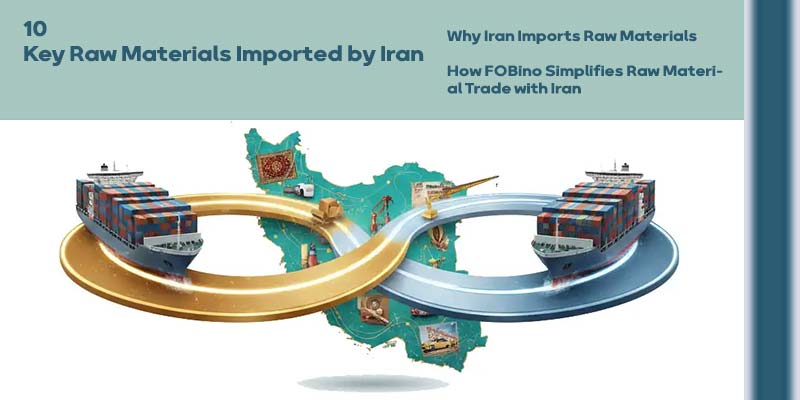
10 Key Raw Materials Imported by Iran
Iran Trade Payments & Risk Management
Last Modified Time : 2/19/2026
Table of contents [ Show ]
FOBino is Iran’s international trade hub, allowing you to easily connect with Iranian manufacturers and buyers. Through the FOBino platform, you can trade with confidence by accessing products available in Iran that are first inspected and quality-controlled by FOBino experts. You can also arrange shipment instructions directly through FOBino, making international trade with Iran more transparent, secure, and efficient.
Why Iran Imports Raw Materials
Although Iran possesses abundant energy resources, a large labor force, and a diversified industrial base, it remains highly dependent on imported raw materials to sustain key sectors of its economy.
Iran’s manufacturing, agriculture, pharmaceutical, automotive, and consumer goods industries operate at a scale that domestic raw material production alone cannot fully support. Factors such as climate limitations, insufficient agricultural yields, technology gaps, and quality requirements drive consistent demand for imported inputs.
With a population of over 85 million, a strong domestic production ecosystem, and ongoing industrial activity, Iran represents a structural and long‑term import market for raw materials. For exporters, understanding what Iran imports—and why—helps identify stable, repeatable business opportunities rather than short‑term or speculative demand.

- Soybeans and Soybean Meal
Soybeans and soybean meal are among Iran’s most critical agricultural imports, primarily supporting the animal feed industry. Iran’s domestic soybean production is limited and cannot meet the needs of its expanding meat and poultry sectors. As a result, the country relies heavily on imports to ensure feed stability and prevent price volatility.
Why Iran Imports It
- Animal feed industry
- Poultry and livestock production
- Food processing (oil, protein products)
Main Suppliers
- Brazil
- Argentina
- Russia
2. Corn (Maize)
Corn is another essential input for Iran’s agricultural and food processing industries, with demand remaining stable regardless of economic conditions. Corn imports play a strategic role in maintaining food security and controlling feed costs.
Key Uses
- Poultry feed
- Starch and glucose production
- Food industry
Import Drivers
- High domestic demand
- Stable consumption regardless of economic cycles
3. Barley
Barley is widely used in Iran’s agricultural supply chain, particularly for animal nutrition.
Iran imports barley to balance seasonal shortages, stabilize market prices, and ensure consistent availability for farmers and feed producers.
Barley is widely used in:
- Livestock feed
- Brewing and food processing
Iran imports barley to stabilize prices and ensure supply for its agricultural sector.
4. Vegetable Oils (Crude & Refined)
Iran imports large volumes of:
- Palm oil
- Soybean oil
- Sunflower oil
Why?
- Domestic oilseed production is insufficient
- High demand from households and food factories
Vegetable oils are among Iran’s most strategic food imports.
5. Pharmaceutical Raw Materials (APIs)
Pharmaceutical raw materials, particularly Active Pharmaceutical Ingredients (APIs), are among the most strategically important imports for Iran because they form the core building blocks of domestic drug production. Although Iran has a well‑established pharmaceutical manufacturing sector and produces a wide range of finished medicines locally, it lacks sufficient capacity to manufacture many high‑purity and complex APIs at an industrial scale. As a result, pharmaceutical companies depend on imports to meet regulatory standards, ensure bioequivalence, and maintain consistent product quality. APIs are mainly imported for the production of generic drugs, chronic disease medications, antibiotics, and hospital‑grade treatments, with China, India, and selected European suppliers playing a dominant role. Given Iran’s large population, rising healthcare demand, and policy focus on domestic drug manufacturing, the need for imported pharmaceutical raw materials remains structurally strong and long‑term.
What Are APIs?
Active Pharmaceutical Ingredients (APIs) are the core components of medicines.
Why Iran Imports Them
- Strong domestic pharmaceutical manufacturing
- Limited local API production
- High quality requirements
Main Supplier Countries
- China
- India
- European Union
6. Chemical Raw Materials
Chemical raw materials represent a critical import category for Iran despite the country’s extensive petrochemical infrastructure, because many downstream industries require specialty chemicals that are not produced domestically in sufficient quality or variety. Imported chemical inputs are used in a wide range of sectors, including pharmaceuticals, paints and coatings, detergents, plastics, agriculture, and industrial manufacturing, where precise formulations and consistent purity levels are essential. These materials often include specialty additives, catalysts, laboratory reagents, and performance chemicals that require advanced production technologies. The growing demand for higher‑quality consumer and industrial products has further increased reliance on imported chemical raw materials, making this segment an attractive and technically driven market for international suppliers with specialized capabilities.
Examples
- Specialty chemicals
- Laboratory chemicals
- Industrial additives
Main Uses
- Paints and coatings
- Detergents
- Plastics
- Pharmaceuticals
7. Pulp and Paper Raw Materials
Iran imports significant volumes of pulp and paper raw materials due to structural limitations in domestic supply, particularly the lack of sufficient forest resources and environmental constraints on large‑scale wood harvesting. Imported pulp is essential for supporting industries such as packaging, publishing, tissue production, and hygiene products, all of which rely on consistent fiber quality and reliable supply. The expansion of food packaging, consumer goods manufacturing, and e‑commerce has further increased demand for paper‑based materials, while hygiene products such as tissues and paper towels require high‑quality pulp that is often sourced internationally. As a result, pulp and paper raw materials remain a stable and long‑term import category closely linked to Iran’s industrial and consumer markets.
Iran imports:
- Wood pulp
- Paper pulp
- Specialized paper materials
Why?
- Limited forest resources
- High demand from publishing, packaging, and hygiene industries
8. Natural Rubber
Natural rubber is a vital industrial raw material for Iran, particularly for the automotive, transportation, and manufacturing sectors, where it is used in tire production, rubber components, seals, hoses, and various mechanical applications. Due to unsuitable climate conditions, Iran cannot produce natural rubber on a meaningful scale, making imports unavoidable. Most natural rubber is sourced from Southeast Asian countries with established rubber plantations and processing industries. Demand for natural rubber in Iran closely follows vehicle production levels, tire replacement cycles, and industrial maintenance activity, ensuring steady import needs as long as these sectors remain active. This makes natural rubber a structurally necessary input rather than a discretionary import.
Natural rubber is essential for:
- Tire manufacturing
- Automotive parts
- Industrial goods
Iran imports natural rubber mainly from Southeast Asia due to climate limitations.
9. Industrial Machinery Parts & Components
Although not a “raw material” in the classic sense, machinery parts are critical production inputs.
Industrial machinery parts and components function as essential production inputs for Iranian factories, even though they are not traditional raw materials. Bearings, motors, gear systems, control units, and automation components are critical for maintaining continuous operation across manufacturing sectors such as steel, cement, food processing, petrochemicals, and consumer goods. Iran imports these components primarily to replace worn equipment, prevent production downtime, and maintain efficiency in facilities that often operate with aging or mixed‑generation machinery. Because maintenance and repair are ongoing needs regardless of economic cycles, imports of industrial machinery parts represent a consistent and demand‑driven market rather than one dependent on new investment alone.
Examples
- Bearings
- Industrial motors
- Control systems
These imports keep factories running and prevent production downtime.
10. Cotton Fiber
Cotton fiber imports play a strategic role in sustaining Iran’s textile and apparel industries, which rely on stable access to high‑quality raw materials to remain competitive. While Iran does produce cotton domestically, local output is insufficient in both volume and quality, particularly for long‑staple fibers required for premium yarns, fabrics, and export‑oriented textile products. Imported cotton fiber enables textile mills and garment manufacturers to achieve consistent product quality and meet market expectations. Given Iran’s strong domestic textile base and relatively low labor costs, demand for imported cotton remains stable and structurally linked to the performance of the country’s textile and apparel sector.
Iran imports cotton fiber to support:
- Textile mills
- Apparel production
- Home textile manufacturing
Domestic cotton production does not fully meet industry demand, especially for high-quality fiber.
Comparison Table: Key Imported Raw Materials
|
Raw Material |
Main Industry |
Import Dependency |
|
Soybeans |
Livestock |
Very High |
|
Corn |
Poultry |
Very High |
|
Vegetable Oils |
Food |
High |
|
APIs |
Pharma |
High |
|
Chemicals |
Industry |
Medium–High |
|
Pulp |
Packaging |
High |
|
Natural Rubber |
Automotive |
High |
|
Cotton |
Textile |
Medium |
|
Machinery Parts |
Manufacturing |
High |
|
Barley |
Agriculture |
Medium |
Why These Imports Matter for Global Exporters
Iran’s economy relies on stable access to raw materials. This creates opportunities for:
- Agricultural exporters
- Chemical suppliers
- Pharmaceutical manufacturers
- Industrial component producers
Despite trade challenges, demand for these inputs remains structural and ongoing.
Key Challenges in Supplying Raw Materials to Iran
- Payment mechanisms
- Logistics coordination
- Quality verification
- Regulatory compliance
This is why working through a trusted B2B platform is essential.
How FOBino Simplifies Raw Material Trade with Iran
FOBino helps exporters and Iranian buyers by:
- Connecting verified buyers and suppliers
- Enabling quality inspection in Iran
- Supporting logistics coordination
- Reducing communication and trade risks
Final Thoughts
For access to buyers and sellers of raw materials in Iran, go to FOBino and trade with ease. Keep in mind that the Iranian market is like an ocean of opportunity where products can be supplied at competitive prices with consistent demand. Due to the low value of the Iranian rial at the time of writing and affordable labor costs, many Iranian manufacturers are highly cost-competitive—creating strong long-term demand for imported raw materials and offering attractive business opportunities for global suppliers.
🔗 Visit www.fobino.com to start trading simply and confidently.